
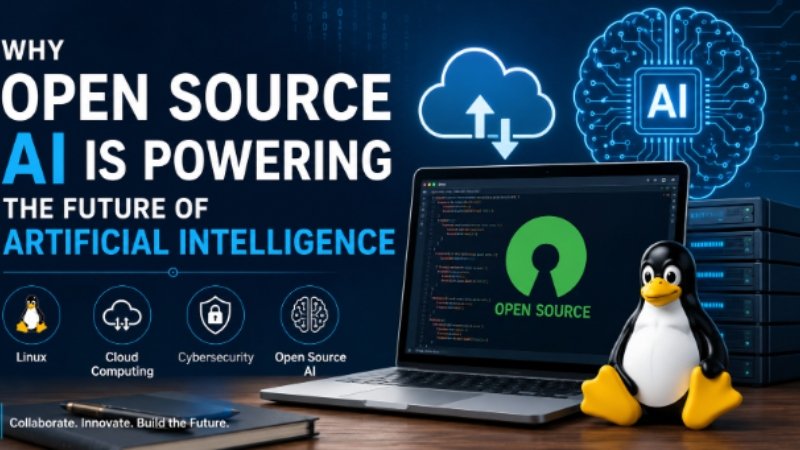
Artificial intelligence has become one of the fastest-growing technologies in recent years. From chatbots and virtual assistants to medical research and software development, AI is changing how people work and solve problems. While many companies develop proprietary AI solutions, open-source projects continue to play a major role in making AI accessible to everyone.
Open-source AI allows developers, researchers, and businesses to study, modify, and improve existing tools instead of building everything from scratch. This collaborative approach encourages innovation while reducing development costs.
What Is Open Source AI?
Open Source AI refers to artificial intelligence software, frameworks, and models whose source code is publicly available. Developers can inspect the code, contribute improvements, fix bugs, and customize features according to their own requirements.
Popular open-source AI frameworks include TensorFlow, PyTorch, Hugging Face Transformers, and ONNX. These projects have created large communities that continuously improve the technology.
Why Businesses Prefer Open Source Solutions
Many organizations are choosing open-source software because it offers flexibility without expensive licensing fees.
Some of the biggest advantages include:
- Lower development costs
- Greater customization
- Strong community support
- Better transparency
- Faster innovation
- Improved security through community review
These benefits make open-source AI attractive for startups as well as enterprise organizations.
Open Source AI vs Proprietary AI
| Feature | Open Source AI | Proprietary AI |
| Cost | Usually free or low-cost | Often requires paid licenses or subscriptions |
| Customization | Highly customizable | Limited customization options |
| Transparency | Source code is publicly available | Source code is not publicly accessible |
| Community Support | Large global developer community | Official vendor support only |
| Innovation Speed | Fast due to community contributions | Depends on the company’s development cycle |
| Vendor Lock-in | Low risk | Higher risk of dependency on one provider |
| Best For | Startups, developers, researchers, and educational use | Large enterprises needing dedicated commercial support |
Why This Comparison Matters
Choosing between open-source and proprietary AI depends on your goals, budget, and technical requirements. Open-source AI offers flexibility, transparency, and cost savings, making it an excellent choice for developers and startups. Proprietary AI, on the other hand, may provide dedicated support and enterprise-grade services for organizations with specific business needs.
The Role of Linux in AI Development
Most AI workloads run on Linux-based systems because they provide stability, flexibility, and excellent performance.
Linux supports major programming languages, GPU drivers, containers, Kubernetes, Docker, and cloud-native applications, making it an ideal environment for machine learning engineers.
Developers building AI models often rely on Linux servers for training large datasets efficiently.
Cloud Computing Accelerates AI Projects
Cloud platforms have made artificial intelligence more accessible than ever.
Instead of purchasing expensive hardware, organizations can rent computing resources only when needed. This approach reduces infrastructure costs while allowing teams to scale projects quickly.
Cloud services also provide ready-made AI tools, storage, databases, and deployment pipelines that simplify development.
Cybersecurity Matters in AI
As AI systems become more common, protecting sensitive data becomes increasingly important.
Organizations should:
- Encrypt training data
- Control user permissions
- Monitor model activity
- Regularly update software
- Detect vulnerabilities early
Combining AI with strong cybersecurity practices helps maintain trust and reliability.
Continuous Learning Drives Better Innovation
Technology evolves rapidly, making continuous learning essential for developers and IT professionals.
Following reliable technology resources helps readers stay informed about:
- Linux tutorials
- AI developments
- Cloud computing
- DevOps practices
- Cybersecurity updates
- Programming techniques
For readers looking to explore practical tutorials and industry insights, platforms like PBLinuxTechBlogs provide valuable educational content covering Linux, AI, cloud computing, DevOps, cybersecurity, and modern software development topics.
The Future of Open Source AI
The future of artificial intelligence will likely depend heavily on collaboration.
Open-source communities continue to release better models, improved frameworks, and innovative development tools that help businesses create smarter applications more efficiently.
As more organizations embrace transparency and collaboration, open-source AI will remain a driving force behind technological innovation.
Conclusion
Open-source AI has transformed how developers build intelligent applications. Combined with Linux, cloud computing, and strong cybersecurity practices, it creates a powerful foundation for modern software development.
Whether you’re a student, developer, or business owner, staying updated with reliable technology resources and continuously improving your skills will help you adapt to the rapidly changing digital landscape.