
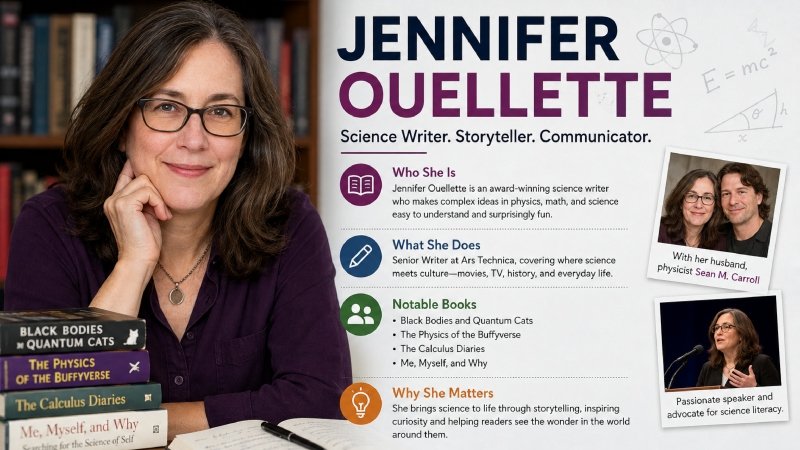
Jennifer Ouellette has built a long career around one difficult task: explaining science to people who may not have a scientific background. Rather than treating physics as a subject limited to laboratories and textbooks, she often connects it with culture, entertainment, mathematics, and everyday life.
Today, Ouellette is a senior writer at Ars Technica, where she covers science and culture, including physics and the science behind films and television. Ars Technica says she has written professionally about physics and related subjects for more than two decades.
She also has a strong background in popular science books, magazine writing, and science communication. Her career includes work with the National Academies’ Science & Entertainment Exchange, as well as previous roles at Gizmodo and Scientific American.
Jennifer Ouellette Quick Facts
| Category | Details |
|---|---|
| Full Name | Jennifer Ouellette |
| Profession | Science writer and editor |
| Birth Year | 1964 |
| Birthplace | Ashland, Wisconsin, U.S. |
| Education | B.A. in English, Seattle Pacific University |
| Graduation | 1985 |
| Current Role | Senior Writer, Ars Technica |
| Known For | Popular science writing and science communication |
| Spouse | Physicist Sean M. Carroll |
| Notable Books | Black Bodies and Quantum Cats, The Physics of the Buffyverse, The Calculus Diaries, Me, Myself and Why |
Note: Some entertainment databases list May 17, 1964, as Ouellette’s birthday, but the stronger biographical sources reviewed here consistently establish her birth year and birthplace rather than providing a fully verified birth date.
Early Life and Education
Jennifer Ouellette was born in Ashland, Wisconsin, in 1964. She later attended Seattle Pacific University, where she studied English. She graduated with a bachelor’s degree in English in 1985.
Her educational background is important because she did not begin her career as a traditionally trained physicist. Instead, her strength came from writing, storytelling, and her ability to make complicated subjects understandable.
That combination eventually became a major part of her identity as a science writer.
Rather than approaching science only through technical formulas, Ouellette learned to explain scientific ideas through stories, cultural references, and familiar examples.
How Jennifer Ouellette Became a Science Writer
Ouellette’s career developed gradually. Her background in English gave her strong writing and communication skills, while her growing interest in science led her toward science journalism.
According to biographical information available about her career, she worked as a contributing editor for The Industrial Physicist from 1995 to 2004 and also worked with APS News, the publication of the American Physical Society.
Her writing eventually appeared in publications including Discover, Nature, New Scientist, Physics World, Smithsonian, The Wall Street Journal, and The Washington Post.
This range demonstrates the unusual combination at the center of her career: she could discuss serious scientific subjects while still writing for a broad audience.
Jennifer Ouellette at Scientific American
Ouellette became particularly recognizable through her Cocktail Party Physics blog.
She began writing the blog for Scientific American in 2006. The concept reflected her approach to science communication: science could be discussed in an informal, entertaining setting rather than only in classrooms or academic journals.
The blog helped establish her reputation for connecting science with culture.
That approach remains visible in her later work, where physics can appear alongside movies, television, mathematics, history, and popular culture.
Science and Entertainment Exchange
One of the most notable chapters in Ouellette’s career came when she became involved with the Science & Entertainment Exchange, an initiative of the National Academy of Sciences.
Ars Technica identifies her as the founding director of the program from 2008 to 2010.
The program was created to connect entertainment professionals with scientists and engineers. The goal was to help filmmakers, television producers, writers, and other creators incorporate science more accurately into entertainment.
This role was a natural fit for Ouellette because her career already crossed the boundaries between science and popular culture.
Her work showed that scientific accuracy does not have to make entertainment less interesting. Instead, scientific ideas can provide better stories and more believable worlds.
Jennifer Ouellette at Gizmodo and Ars Technica
Ouellette later became senior science editor at Gizmodo, adding another major digital-media position to her career. She joined Ars Technica as a contributor in 2018.
Ars Technica currently lists her as a Senior Writer. The publication says her coverage focuses on where science meets culture, including physics, interdisciplinary science, films, and television.
Her recent Ars Technica work shows how broad that role has become.
Her articles have covered subjects ranging from physics research and animal behavior to archaeology, science-related discoveries, television, movies, and popular culture.
This is one reason her career stands out. She does not treat science and culture as completely separate worlds.
Jennifer Ouellette’s Books
Ouellette has written several popular science books that introduce scientific ideas through unusual and accessible subjects.
Black Bodies and Quantum Cats
Published by Penguin Books in 2005, Black Bodies and Quantum Cats: Tales from the Annals of Physics uses stories from science and culture to explain concepts in physics. Penguin Random House describes the book as an exploration of physics through examples drawn from subjects such as films, literature, and scientific history.
The book demonstrates Ouellette’s central writing style: instead of presenting physics as a collection of abstract formulas, she places scientific ideas inside recognizable stories.
The Physics of the Buffyverse
Another well-known book is The Physics of the Buffyverse.
The book uses the television series Buffy the Vampire Slayer as a way to explore physics concepts. The unusual combination allows readers to approach scientific ideas through a familiar fictional world.
It also reflects Ouellette’s broader interest in the relationship between science and entertainment.
The Calculus Diaries
In The Calculus Diaries, Ouellette explores mathematics through everyday experiences.
The book aims to make calculus less intimidating by showing how mathematical thinking can appear in ordinary situations, games, and practical problems.
Me, Myself, and Why
Published in 2014, Me, Myself, and Why: Searching for the Science of Self explores questions surrounding identity and the science behind human behavior.
The book combines scientific discussion with personal exploration, another example of Ouellette’s preference for connecting technical subjects with real human experiences.
Ars Technica currently lists these books among her major popular-science works.
What Makes Jennifer Ouellette’s Writing Different?
Ouellette’s career is notable because she combines two skill sets that do not always appear together.
First, she understands the importance of scientific accuracy.
Second, she understands how to tell a story.
Her English degree gave her a foundation in writing, while years of reporting and working around scientists gave her experience with scientific subjects.
This combination allows her to ask a simple question: How can a complicated scientific idea become interesting to someone who is not a scientist?
Her answer is often to connect the subject with something people already understand.
A movie can explain physics. A mathematical problem can become a personal challenge. An unusual scientific discovery can become a story about human curiosity.
That approach makes science feel less distant.
Jennifer Ouellette and Sean Carroll
Jennifer Ouellette is married to theoretical physicist and author Sean M. Carroll.
Carroll’s own website identifies Ouellette as his wife and describes her as a writer.
Their professional interests overlap in an obvious way. Carroll works in theoretical physics and writes about science and philosophy, while Ouellette focuses on science writing and communication.
However, it is important not to overstate their professional relationship. Their individual careers remain distinct.
Ouellette has established her own reputation through journalism, books, and science communication rather than simply through her connection to Carroll.
Where Does Jennifer Ouellette Live?
Ars Technica currently says that Ouellette lives in Baltimore with her spouse, Sean M. Carroll.
Older publisher information has listed different locations at different points in her career, so current biographical information is more useful than older book descriptions.
Jennifer Ouellette’s Role in Modern Science Communication
Ouellette’s importance goes beyond the books she has written.
Her career demonstrates how science communication has changed.
Science information once reached the public mainly through newspapers, magazines, television documentaries, and books. Today, science writers also work through digital publications, blogs, social media, podcasts, video, and online communities.
Ouellette has worked across many of these formats.
Her current work at Ars Technica is especially relevant because the publication allows her to combine scientific reporting with culture and entertainment coverage.
Jennifer Ouellette Career Timeline
| Year/Period | Career Milestone |
|---|---|
| 1964 | Born in Ashland, Wisconsin |
| 1985 | Earned B.A. in English from Seattle Pacific University |
| 1995–2004 | Contributing editor at The Industrial Physicist |
| 2006 | Began Cocktail Party Physics at Scientific American |
| 2008–2010 | Founding director of Science & Entertainment Exchange |
| 2015 | Became senior science editor at Gizmodo |
| 2018 | Joined Ars Technica as a contributor |
| 2026 | Listed as a Senior Writer at Ars Technica |
The career dates above are based primarily on Ars Technica’s current author biography and available biographical records.
Frequently Asked Questions
Who is Jennifer Ouellette?
Jennifer Ouellette is an American science writer and editor known for explaining physics, mathematics, science, and culture to general audiences. She is currently a senior writer at Ars Technica.
When was Jennifer Ouellette born?
Jennifer Ouellette was born in 1964 in Ashland, Wisconsin. Some databases list May 17 as her birthday, but the exact date is not consistently confirmed by the strongest sources reviewed.
Where did Jennifer Ouellette go to college?
She attended Seattle Pacific University and earned a bachelor’s degree in English in 1985.
Is Jennifer Ouellette a physicist?
No. Ouellette is a science writer and editor, not a physicist. Her academic background is in English, and her expertise comes from years of science journalism and communication.
Who is Jennifer Ouellette’s husband?
Jennifer Ouellette is married to physicist and science author Sean M. Carroll. Carroll’s own website confirms that Ouellette is his wife.
What books did Jennifer Ouellette write?
Her books include Black Bodies and Quantum Cats, The Physics of the Buffyverse, The Calculus Diaries, and Me, Myself and Why.
What is Jennifer Ouellette known for?
She is best known for making science accessible to general readers and for connecting scientific ideas with culture, entertainment, and everyday life. Ars Technica currently describes her work as covering the intersection of science and culture.
Conclusion
Jennifer Ouellette’s career offers an interesting example of how a person can enter science communication without beginning with a science degree.
She studied English at Seattle Pacific University, developed a career in journalism, and eventually became an established science writer and editor. Her work has appeared across major publications, while her books have explored physics, mathematics, identity, and popular culture.
Her role with the Science & Entertainment Exchange also placed her at an important intersection between scientific expertise and the entertainment industry. Today, she continues that broader mission through her work as a senior writer at Ars Technica.
The strongest part of Jennifer Ouellette’s story is not simply that she writes about science. It is how she writes about it. By combining storytelling with scientific ideas, she has helped make subjects such as physics and mathematics more approachable for readers who might otherwise find them intimidating.
Her career shows that science communication does not require choosing between accuracy and storytelling. The two can work together—and that combination has become the defining feature of Jennifer Ouellette’s work.